
Human Rights Beyond the Headlines: Activism Comes in Many Forms
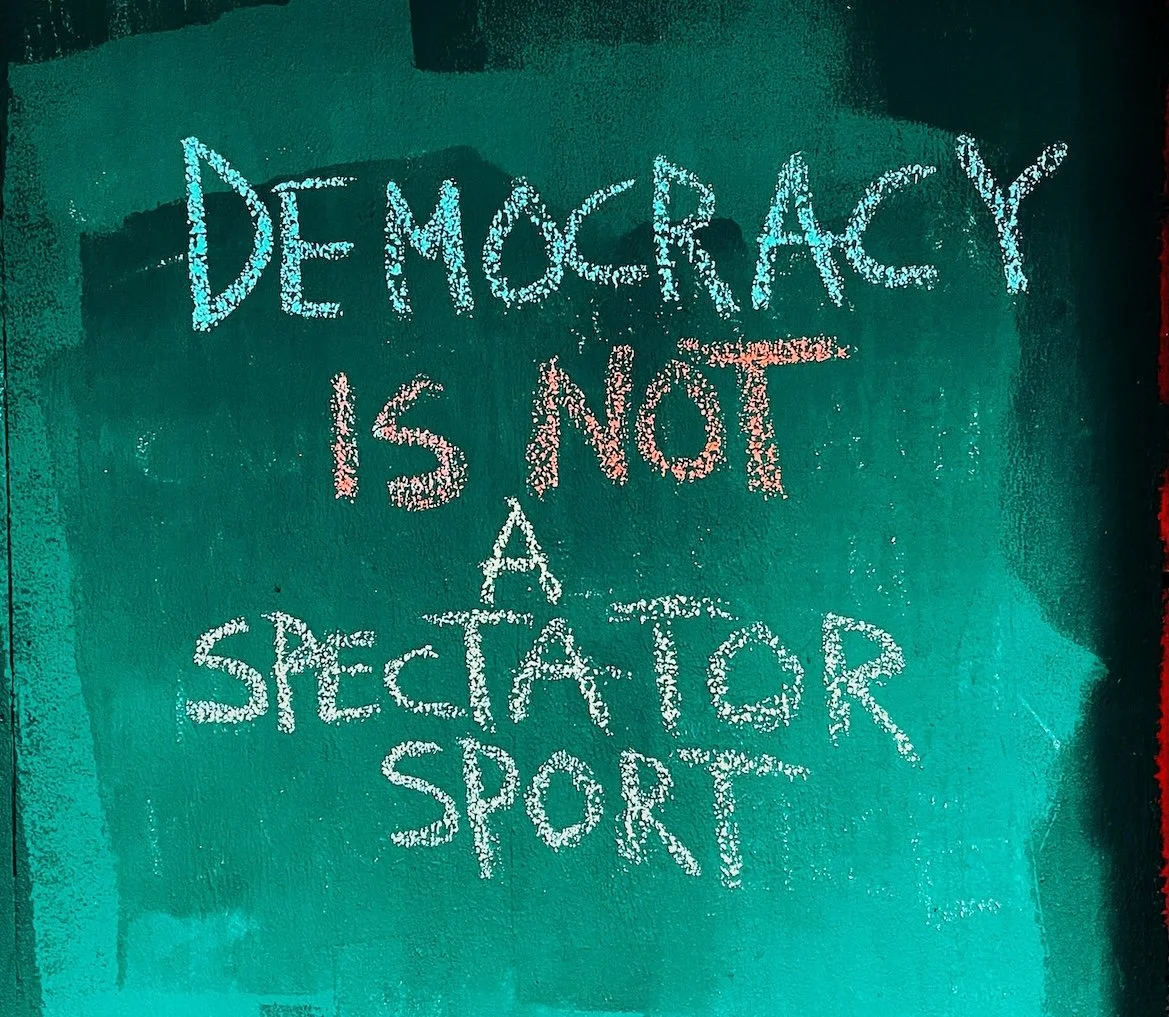
“Democracy is not a spectator sport” (credit: Jon Tyson/Unsplash)
In late 2025 and early 2026, the world watched as Minneapolis, Minnesota erupted in activism. The people there were responding to Operation Metro Surge, a “surge” of 3000 federal ICE (Immigration and Customs Enforcement) agents on their streets to apprehend and deport undocumented immigrants. As they watched people being mistreated–pepper-sprayed, harassed, and even murdered in their streets–and the rights of citizens and non-citizens being violated, the people pushed back and resisted in various ways. The people of Minneapolis:
Held protests and vigils
Formed human blockades
Established warning networks by alerting neighborhoods of ICE presence
Demanded hotels ban ICE agents
Closed businesses in solidarity
Engaged in mutual aid
Organized food deliveries and transportation for people afraid to leave their homes
Trained legal observers to document arrests
Followed immigration convoys
Filed lawsuits
The word “activism” typically evokes images of large protests with people holding signs and marching in the streets; however, activism takes many shapes and forms.
What to Know
(Background information for educators and can be read aloud, shared, or summarized with learners)
What is activism and resistance?
Activism is action taken for social or political change, usually challenging those in power. This means that when people want things to change in their communities, society, or the world, they take action and do something about it. Another way to talk about activism is to call it resistance. Social and political resistance refers to actions people or groups take to challenge and oppose systems of power, oppression, or inequality. With resistance, there is a focused intent to challenge inequity and injustice.
Activism and resistance can take many forms. The actions can be large or small, quiet or loud, private or public, slow or fast, ordinary or extraordinary. Here are some forms of activism:
Protests, demonstrations, walkouts, and vigils bring people together, help participants feel like they are part of something bigger, create a public display and statement about what’s happening, get media attention, and inspire others to learn and get involved.
Sit-ins and boycotts are public refusals to buy from or engage with a person or company contributing to injustice. They raise public awareness about the issue and pressure that person or company to change their policies or positions.
Lawsuits address laws being violated and harm being caused, and can hold people, organizations, or institutions accountable for those harms and injustices.
Social and other media bring public awareness to an issue and inspire others to take action.
Legislative advocacy includes contacting representatives or making public statements in support of laws that address bias and injustice.
Running for office or volunteering with a campaign helps elect representatives who share your concerns and opinions about the important issues of the day.
Raising or donating funds contributes to the causes you care about and provides the money necessary to support people and organizations working on them.
Volunteering or helping with mutual aid (people supporting eachother with resources or services) helps others who are dealing with the issue directly and fosters compassion, understanding, and empathy.
Civil disobedience is a strategy to nonviolently disobey laws that are unjust or unfair, and to bring awareness to the injustice.
Educating others helps to inform others about the issue and may propel them to act.
Art (performing or visual art) can inspire others and affect people emotionally, often inspiring empathy and compassion.
Public testimony gives a public voice to the issue and may suggest strategies to make change.
Petitions are written requests to influence public policy or other issues of concern. They can persuade companies, elected officials, and others.
Letter writing helps people clarify and express their opinion about an issue and persuade the recipient (e.g., an individual, company, news outlet, or elected official) to do or say something about it.
Activism makes a difference and helps move the needle toward change by inspiring public sympathy and support, bringing more people into the movement, inspiring legislators to vote for or against legislation, and influencing public opinion and voters. Activism is a fundamental human right and is included in several articles of the Universal Declaration of Human Rights (see below).
Activism in the US
Activism throughout history in the US–often initiated by young people–has been responsible for significant social change. Here are a few examples from the many activist efforts in the US and how they made a difference.
The women’s suffrage movement was a decades-long effort that resulted in women gaining the right to vote in 1920; however, Black and other women of color were often blocked from voting until the Voting Rights Act was passed in 1965.
The Labor Movement has a long and varied history. It began with the intention of improving the rights and conditions of working people. Its achievements include the eight-hour workday, minimum wage, child labor laws, workplace safety laws, employer-provided health insurance, and the right to collective bargaining (i.e., labor unions).
The Civil Rights Movement of the 1950s and 1960s was an effort to bring justice and equity to Black people in the US, resulting in several pieces of landmark legislation (e.g., Civil Rights Act, Voting Rights Act, Fair Housing Act) as well as changing hearts and minds.
The activist movement against the Vietnam War included protests, vigils, draft resistance, and sit-ins. It helped turn public opinion against the war and put pressure on the US government to end it.
In the 1960s, the Agricultural Workers Organizing Committee (AWOC) organized a boycott of non-union grapes to support better wages for workers. This boycott resulted in a victory for farmworkers.
The disability rights movement has a long history, with activism dating back to the 1800s. The movement is responsible for major achievements, including the 1990 Americans with Disabilities Act (ADA), which prohibits discrimination against people with disabilities.
In 2013, after decades of grassroots organizing and activism, the US Supreme Court ruled in favor of same-sex marriage across the country. Marriage equality is part of the larger movement for LGBTQIA+ rights and equality.
The movement against gun violence (which was propelled by the 1999 Columbine shooting) has resulted in the creation of various organizations and some federal and state legislation.
The Black Lives Matter (BLM) movement, founded in 2013, began as a hashtag following the fatal shooting of Trayvon Martin, an unarmed teenager, by George Zimmerman. The movement expanded following fatal shooting by police across the US, including the 2020 murder of George Floyd. The impact and achievements of the BLM movement include increased public awareness about the issue, the creation of other grassroots organizations for racial justice, policy changes in local policing practices, improved data collection efforts, etc.
The MeToo movement was started in 2006 by Tarana Burke to support survivors of sexual abuse/harassment and to hold perpetrators accountable. The now global movement raised public awareness and empathy about the issue, changed policy and laws, and exposed many powerful people (mostly men). Some were held accountable with job terminations, arrests, and lawsuits.
In the 2020s, the pro-democracy movement and efforts to resist authoritarianism included No Kings protests. An estimated 8 million people in March 2026 participating in simultaneous “No Kings” protests across the country.
While many of these achievements are impactful and powerful, the struggle doesn’t usually end when legislation or other goals are achieved. There is always more work to be done to move toward a more just and equitable world.
Activism and resistance throughout history and around the globe
Activism and resistance are universal. From the anti-Apartheid movement in South Africa to girls’ rights to an education in Pakistan, fighting against oppression and inequality has taken place over thousands of years and in countries across the globe. In these movements, activists have used a variety of strategies to bring about change in their countries and the world. Here are additional resources to learn about some of these movements:
9 Powerful Social Change Movements You Need to Know About (Amnesty International)
9 Human Rights Movements Around the World (Human Rights Careers)
100 Campaigns that Changed the World (The Commons Social Change Library)
List of Social Movements (Britannica)
Social Movements—and Their Leaders—That Changed Our World (Global Citizen)
Why It Matters
Activism matters because is has proven to be an important catalyst for change. So much of the important social change around the world has been brought about by people engaging in activism and resistance. People working together to challenge societal bias, injustice, and oppression make a difference.
Activism can also be patriotic. As James Baldwin famously said, “I love America more than any other country in the world, and, exactly for this reason, I insist on the right to criticize her perpetually.” Indeed, true patriotism means that we commit to making our country better for everyone.
What You Can Do Right Now
(Ideas for learners to take action)
Identify the issues you care about and learn more about those topics so you can determine how you can get involved and make a difference.
Investigate and participate in local, state, or national activism efforts, or start something local that aligns with your interests and concerns. If there isn’t a group that already exists, you can start one in your school or community. As Margaret Mead said, "Never doubt that a small group of thoughtful, committed citizens can change the world; indeed, it's the only thing that ever has."
Discover more about activism and resistance throughout history and around the world. Hold an educational forum in school to learn more.
Run for a student council office in your school (or assist others’ campaigns) by exploring the school and community issues you care about and what you plan to do about those issues. You can also attend school board meetings in your community; many school boards allow students to become members or representatives.
Conversation Starters and Sparkers
To engage learners in a discussion, use non-judgmental and open-ended questions. Non-judgmental questions are curious questions that seek to understand a person, perspective, or situation without making assumptions or judgments. Open-ended questions are broad questions that can’t be answered in one word or with a simple “yes” or no,” but instead are questions that lead to detailed responses that uncover a person’s opinions or feelings and keep the conversation flowing.
Ask any of the following questions or create your own questions:
What does activism mean to you? What does resistance mean to you?
What did you learn about activism and resistance that you didn’t know before?
Have you ever witnessed activism or resistance? What was it about?
How does it feel when you do something to make a difference?
What does activism have to do with democracy?
What are the goals of activism and resistance?
What do you want your friends and family to know about activism?
What forms of activism do you want to know more about?
What issues are important enough to you to do something about them?
Resources for Further Learning
-
-
250 Years of Activism (History)
Portraits of Protest (ACLU)
Resources for Activists (Amnesty International)
The Kid's Guide to Social Action: How To Solve the Social Problems You Choose–and Turn Creative Thinking into Positive Action by Barbara Lewis (Free Spirit Publishing)
We the People Activist Toolkit: Defending a Free America (ACLU)
Woven Teaching believes that human rights education is essential for students and adult learners to understand and assert their own rights and to protect the rights of others. As a result, the Universal Declaration of Human Rights (UDHR) lies at the core of Woven Teaching’s materials. The document’s 30 articles outline fundamental human rights: basic rights and freedoms which every human being is entitled to, regardless of race, religion, birthplace, gender, sexual orientation, or other characteristics. Although its articles are not legally binding, the UDHR serves as a moral compass for the international community. The concepts in this resource connect directly to several UDHR articles, including:
Article 19: Right to express your opinion.
Article 20: Right to gather with others and protest peacefully.
Article 21: Right to participate in your government (vote).
Article 29: Respect the rights of others.