
Human Rights Beyond the Headlines: Voting, Elections, and Why They Matter
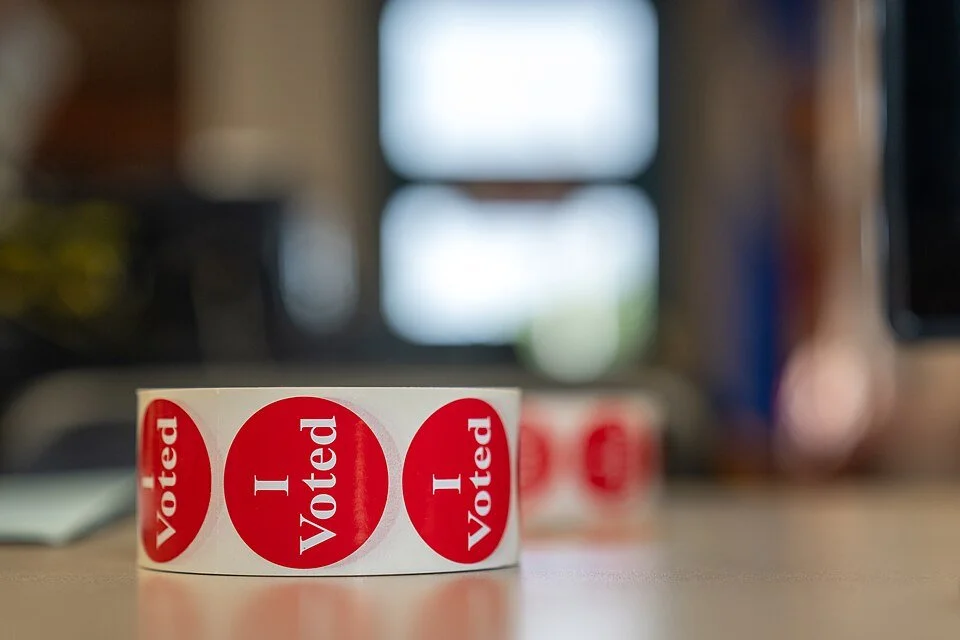
Credit: Laurie Shaull (via Wikimedia Commons)
Have you ever voted for something? Whether it was a presidential election, a student council vote, or an online poll, do you think your vote mattered? Did it make a difference?
We often hear, “your vote is your voice.” But what does this actually mean?
What to Know
(Background information for educators that can be read aloud, shared, or summarized with learners)
What is voting?
Whether casting a vote for an elected official or responding to a survey, voting is expressing our opinion. In a representative democracy like the US, voting provides an opportunity for people to vote for elected officials who will represent their opinions, priorities, and issues they care about. Voting becomes their voice.
Oftentimes people wonder if their vote makes a difference. Does one vote really matter? But if you take that point of view and expand it beyond yourself–if others think the same way or if that attitude is contagious–that number magnifies, and then it is not just one person not voting; it becomes 10 or 100 or 1000 or more.
If you have ever wondered whether your vote matters, consider that since 2018, according to Ballotpedia, there have been 660 US elections decided by ten or fewer votes. Individual votes can make a difference.
Voting in the US
The history of voting in the US is long and complex. In 1789, the Constitution granted states the right to determine their own voting requirements, and only white men who owned property could vote. Over the years, the right to vote expanded to all white men who were over 21 years old. And while the passing of the 15th Amendment to the Constitution in 1870 eliminated race as a factor in determining the right to vote, in reality Black people had to fight for almost 100 years for this right to become real in some states. The Voting Rights Act was passed in 1965, removing barriers that prevented Black and other people of color from voting. In 1971, the voting age was lowered to 18 years old. Currently, in some places, 16- and 17-year-olds are allowed to vote in local elections, like school boards and municipal elections.
There are a variety of elected offices that people can vote for:
Local elections: School boards, mayors, city council members, judges, sheriffs, and others.
State elections: Governors, attorney generals, representatives in the state legislature (state senate and assembly), ballot measures and initiatives.
Federal elections (nationwide): US president, members of Congress (Senate and House of Representatives).
The US Constitution states that the individual states, not the federal government, are responsible for overseeing elections. Local and state administrators run elections, maintain voter registration records, count the ballots, and certify the results. Election rules vary among states because states create election policy (see examples below).
In order to vote, you must first register. Some states have same-day registration, which allows any qualified resident to register to vote and cast a ballot on the same day. Other states have specific deadlines to register (i.e., you must register a certain amount of time before the election). In most cases, a driver’s license or state ID are needed to register, but if you do not have either of these, you may be able to use other documentation.
Years ago, the only way to vote was in person on election day. If you were out of the country, in the military, or away from home on election day, you could request a ballot by mail but a specific reason was required. However, over the past few decades, voting options have greatly expanded. Here are the different ways voting takes place in the US:
Voting in person on election day: Voters go to their voting location and cast their ballot in person.
Early voting in person prior to election day: Currently, forty-seven states and Washington, DC offer voters the opportunity to vote early in person. This means that before election day, there are days designated for voters to go to their voting location and cast their ballot in person.
Vote by mail: Currently, thirty-seven states and Washington, DC, offer voters the option to vote by mail without requiring a reason. Some states require “ballot drop boxes,” which are drop boxes where voters can drop their mail-in ballot without mailing it. In addition, some states’ elections are almost entirely by mail where all active registered voters are sent a ballot in the mail.
Although early voting and voting by mail are meaningful improvements in making voting easier and more accessible, there are ongoing threats to these and other voting methods because of voter suppression efforts (see next section).
The right to vote vs. the ability to vote
The right and ability to vote makes other rights possible. The purpose of a representative democracy is to elect officials who will represent the people’s views, positions, and support the issues that are important to them. If the ability to vote is restricted or voting is suppressed, people are not able to vote for the elected officials they wish to represent them. Therefore, the ability to vote and have our votes counted is critical.
In the US and around the world, sometimes the right to vote is threatened. As a result, specific groups of people are unable to vote because restrictions are placed in an attempt to make the vote go a certain way. Voter suppression laws and strategies suppress or decrease people’s ability to vote and, in turn, threaten democracy.
Voter suppression is when government and elected officials pass rules and laws that discourage and prevent people from voting. Examples of this include purging eligible voters, limiting early voting and mail-in voting, gerrymandering congressional maps, eliminating voting locations, etc. To learn more about voter suppression, read Human Rights Beyond the Headlines: Exploring Voting Rights and Voter Suppression.
Voting across the globe
Voting rules, ages, policies, and restrictions vary around the world. Many countries require voters to be eighteen years old to vote. Among countries around the world, there are three general policies around voting: universal (everyone eligible can vote), mandatory (everyone eligible must vote), and selective (voting eligibility is based on specific qualifications).
The way people vote in countries around the world varies. Some countries use electronic voting instead of paper ballots. Estonia is the first country to use internet voting, where citizens can vote from anywhere in the world. Other methods include using symbols instead of names (in countries where many do not read or write the official language), and fingerprint technology, using fingerprints to confirm identity.
Worldwide, there are important election and voting trends to be aware of. They are included in IDEA’s (Institute for Democracy and Electoral Assistance) “2024 Super-Cycle Year of Elections” report, and some of their findings are:
Changes in electoral systems are a topic of concern because of democratic backsliding.
Election-related misconduct remains an ongoing problem in elections. Accusations of fraud, including vote buying and financial irregularities, were recorded in at least seventeen national elections.
Election-related violence continues to occur, with patterns and degrees of violence varying between countries.
Gender-based violence during election periods was recorded in twenty-eight national elections across public, private, and online spaces.
Forty-three national elections involved instances of mis- and disinformation that undermined the credibility of political actors or the electoral process.
Why It Matters
Democracy is a political system in which the power is vested in the people and exercised by them directly or indirectly through a system of representation, usually involving free and fair elections. The heart of living in a democracy is being able to use your voice, express your views, and be represented using the power of your vote. Caring about and participating in the decisions that impact schools, communities, and society must include voting and free and fair elections. Civic engagement does not begin or end with voting, but voting is one of the most important ways citizens can live up to the power vested in the people.
What You Can Do Right Now
(Ideas for learners to take action)
Help organize a forum at school or in the community about the importance of voting, what it is, how it works, and how others can get involved. Invite speakers with expertise about the voting and electoral process, and the role voting plays in democracy.
Learn about your state voting requirements and other relevant information, the different ways you can vote, and share this information with others.
Find out who your elected officials are and learn about their positions and voting records. Elected officials include your local government, like the mayor or city council member. If you are in the US, search by your address to find contact information for your member of Congress.
Get involved in election activities by learning about and campaigning for candidates, encouraging and helping with voter registration, or volunteering to help during the elections.
Register to vote if you are eligible, and encourage friends, family, neighbors, and peers to register and vote
Conversation Starters and Sparkers
To engage learners in a discussion, use non-judgmental and open-ended questions. Non-judgmental questions are curious questions that seek to understand a person, perspective, or situation without making assumptions or judgments. Open-ended questions are broad questions that can’t be answered in one word or with a simple “yes” or no,” but instead are questions that lead to detailed responses that uncover a person’s opinions or feelings and keep the conversation flowing.
Ask any of the following questions or create your own questions:
How would you describe voting to someone else?
What is it like to vote for something?
What did you learn about voting that you did not know before?
Have you ever voted in an election? If you have not voted, have you gone with a parent or family member or encouraged others to vote?
Do you know the rules for voting in your state or city/town? Do you know how to find out?
What is the purpose of early voting or mail-in voting?
Why do you think some states or elected officials want to restrict or suppress voting?
What are some ideas you have about making voting easier and more accessible for all?
What’s your biggest takeaway from learning more about voting?
Resources for Further Learning
-
Defending Democracy: Lessons for Building Resilience and Taking Action
Human Rights Are for Everyone: A Guide to Teaching for Positive Change
Human Rights Beyond the Headlines: Exploring Voting Rights and Voter Suppression
Human Rights Beyond the Headlines: Let's Talk about Democracy!
-
Voting & Elections (Brennan Center for Justice)
Woven Teaching believes that human rights education is essential for students and adult learners to understand and assert their own rights and to protect the rights of others. As a result, the Universal Declaration of Human Rights (UDHR) lies at the core of Woven Teaching’s materials. The document’s 30 articles outline fundamental human rights: basic rights and freedoms which every human being is entitled to, regardless of race, religion, birthplace, gender, sexual orientation, or other characteristics. Although its articles are not legally binding, the UDHR serves as a moral compass for the international community. The concepts in this resource connect directly to several UDHR articles, including:
Article 19: Right to express your opinion.
Article 21: Right to participate in your government and vote.