
Human Rights Beyond the Headlines: Exploring Voting Rights and Voter Suppression
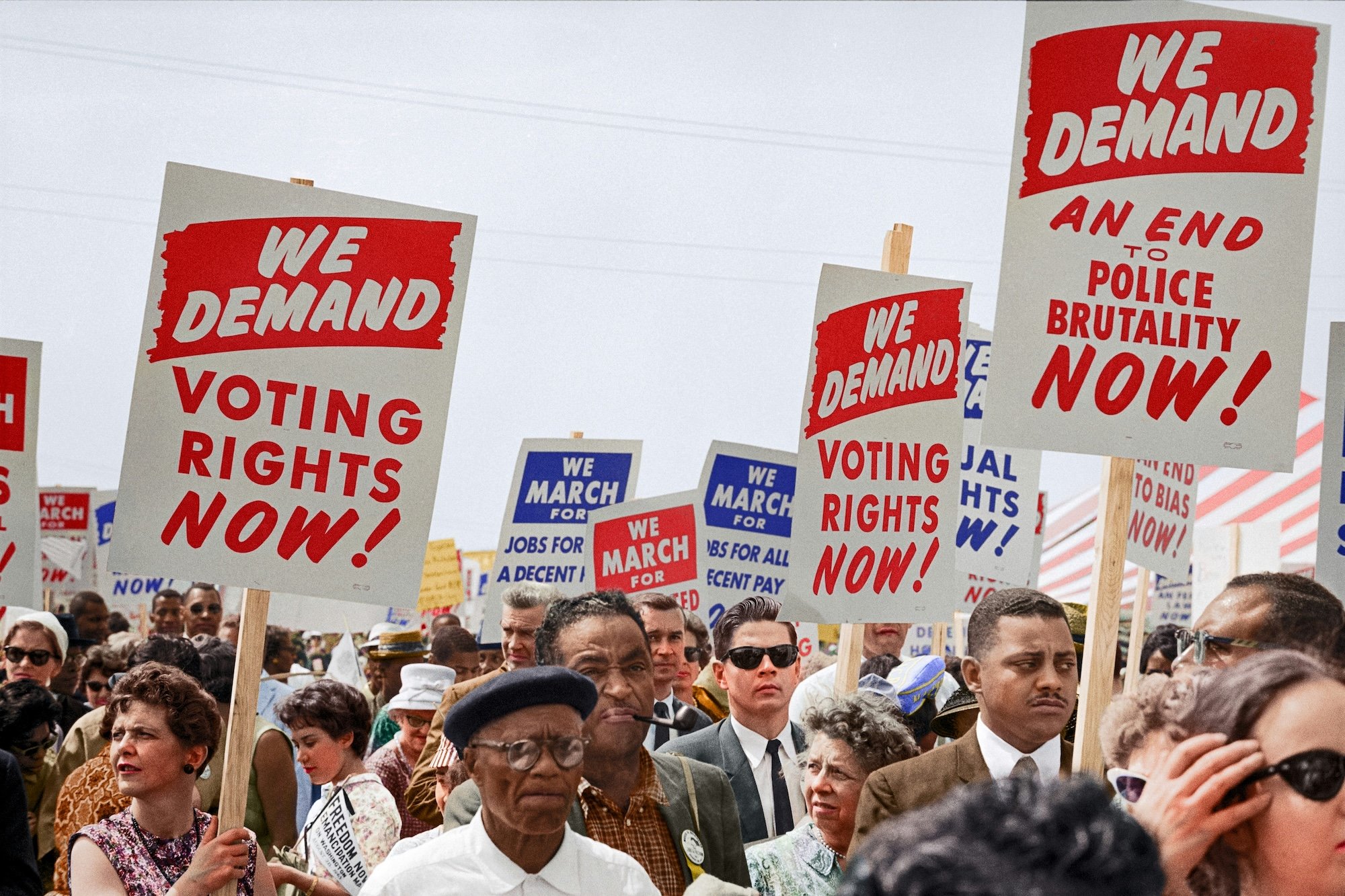
Credit: Marion S. Trikosko (via Unsplash)
Many people say the most important right we have is the right to vote. Voting gives you the ability to make your needs, wishes, values, opinions, and positions known and counted. Voting gives people a voice in the government that represents them.
How are voting rights different in countries around the world? Even when we have the right to vote, do we always have the ability to vote? Does everyone have that ability, or just some people?
What to Know
(Background information for educators that can be read aloud, shared, or summarized with learners)
What is voting?
Voting gives people the chance to make their voices heard about issues in their communities and country. In democratic countries, the right to vote is a central part of being a citizen and participating in democracy. People can vote for elected officials who represent them and their views, and ballot measures or initiatives on specific policies they want enacted. With the right to vote, people can fight for other rights.
Here are some quotes about the importance of voting. What do they mean to you? How do you feel about what is being said? What do they tell you about voting?
“The vote is precious. It is the most powerful non-violent tool we have in a democratic society, and we must use it.”
– John Lewis, late civil rights activist and member of the US House of Representatives for Georgia
“It's not enough to just want change ... You have to go and make change by voting."
– Taylor Swift, singer-songwriter and pop star
"Democracy is the only system that persists in asking the powers that be whether they are the powers that ought to be."
– Sydney J. Harris, US journalist
"Voting is a part of your birthright as a citizen. Don't give it away."
– Former US President Barack Obama
What are the different kinds of voting rights around the world?
In most countries, voting begins at age eighteen. A few countries require voters to reach 21 years of age, and a handful of countries allow sixteen- or seventeen-year-olds to vote. Countries around the world fall into three general categories when it comes to voting:
Universal voting rights mean that all people eligible to vote can vote. Adults who are eighteen years and older (and who are citizens of that country) are usually eligible to vote. Many countries have universal voting rights.
Compulsory or mandatory voting rights means all eligible voters must register and vote in elections. There are different penalties for not voting, and enforcement varies. As of January 2026, 21 countries have compulsory voting laws.
Selective voting rights limit who is allowed to vote, based on qualifications such as property ownership, gender, race, religion, education, etc. There are a few countries around the world that have selective voting rights.
What are voter restrictions and suppression?
Even when people are eligible, qualified, and permitted to vote, they are not always able to vote. Some barriers to voting are ones of convenience, like work schedules that conflict with polling place hours or being out of town on election day. Other barriers can be challenges related to age, mobility, or disabilities for example, which can make it difficult to go to a polling place. In recent years, however, early voting, voting by mail, accessible voting places, and same-day voter registration–which vary among states–have addressed many of those barriers in the US. These strategies expand the ability of people to register and vote, which strengthens democracy.
Voter suppression–laws and tactics which threaten to suppress or decrease people’s ability to vote–can also make voting difficult or nearly impossible. Voter suppression is when government and elected officials (e.g., state legislatures, the Supreme Court, other government officials, etc.) put into place rules and laws that negatively impact people’s ability to vote. Some of these voter suppression tactics include:
Purging eligible voters is when election officials remove registrations for voters they believe are not eligible to vote because they have moved out of the voting district, died, or other reasons. Over the last twenty years, there has been an increase in purging voter rolls, which has caused many eligible voters to have their ability to vote questioned or taken away.
Limits on early voting (voting before election day) and vote by mail (voting by mail in advance of or on election day) happen when these procedures, which expand voting rights and help people vote, are diminished and weakened.
Voter ID requirements are when voters are required to show a specific type of government ID in order to be allowed to vote. Getting an ID can be difficult for many voters. For example, many people are not able to prove their citizenship because they may not have a passport or an easily accessible birth certificate. This results in them not being able to vote.
Disinformation about elections includes spreading inaccurate information about voting and election day, incorrect information about voter registration processes, or claiming the election is “rigged” before it even takes place. These tactics are meant to intimidate voters and can cause them not to vote and suppress voter turnout overall.
Gerrymandering is when elected officials change congressional maps (redistrict). While redistricting is a normal process and maps are revised typically every ten years after the Census, sometimes it is done to control, influence, and unfairly change districts outside of the regular process to give one political party an advantage. Gerrymandering allows politicians to choose their voters rather than voters choosing their elected officials.
Felony disenfranchisement is when people who have been convicted of felony (serious) crimes are not able to vote after serving their time. In addition to being a form of voter suppression, felon disenfranchisement also deepens racial inequalities, as Black citizens often receive harsher sentences than white citizens for the same crime.
Elimination of voting locations is when polling (voting) locations are closed. In the last ten years, more than one in five polling places in the US have closed, making it confusing and more difficult to vote.
How is voter suppression taking place in the US and beyond?
In the US, voting rights have been undermined over the past several years. The struggle for voting rights in the US has a long and complex history; historically, many groups of people have been restricted from voting through laws or other barriers. The Voting Rights Act of 1965, however, cleared an important hurdle, theoretically preventing racial discrimination practices in voting–though many discriminatory practices continue.
Over the past two decades, various Supreme Court rulings and state election laws and policies have contributed to weakening voting rights in the US. They include:
Supreme Court cases such as Shelby County v. Holder (2013), Brnovich v. Democratic National Committee (2021), and Louisiana v. Callais (2026) have done serious damage to the Voting Rights Act. These rulings have re-opened the possibility of discrimination, made it more difficult to challenge discriminatory voting laws, and eliminated protections against lawmakers drawing maps that dilute the political power of minority voters.
Various states have enacted voter suppression laws–including requiring an ID, limiting early and absentee voting, limiting voting by mail, gerrymandering, and purging eligible voters from the voter rolls.
In 2025-26, several Republican-led states enacted mid-decade redistricting to create more seats for themselves in Congress.
President Trump continues to push–and even threatened lawmakers to pass–the SAVE (Safeguard American Voter Eligibility) Act. This act would change the way US citizens register to vote, requiring documentary proof of citizenship in person. For most US citizens, this proof would require a passport or birth certificate, which many people do not have or cannot access easily.
The US is not alone in its voter suppression laws and strategies. In India in 2026, 9.1 million voters were deleted from the register in West Bengal, which represents more than 10 percent of the electorate. Almost one-third of these voters challenged their vote being purged. This process of revising the voter rolls has been happening in states and territories across India.
In Brazil in 2022, during a runoff election, there were widespread accusations that Brazil’s highway police illegally blocked roads in Brazil’s poor northeast area. This sparked fears of voter suppression to benefit then-president Jair Bolsonaro (who was later convicted of a 2022 coup attempt and plotting to overturn election results). Two years later, Brazil's police formally accused the country's former justice minister of blocking voters from reaching polling stations.
During Viktor Orbán’s authoritarian rule as Prime Minister of Hungary from 1998-2002 and again from 2010 to 2026, the government rewrote election laws to favor their party, including by reducing the number of parliamentary seats from 386 to 189 and gerrymandering. Orbán finally lost in 2026, but was accused of mass voter intimidation during the 2026 election.
Why It Matters
Voting is the foundation for any democracy. Voting not only makes other rights possible, but it also gives the people of that country the right to be represented and have their voices heard. Voter restrictions and suppression diminish voting, which weakens democracy. If everyone does not have equal access and opportunity to vote, then our elections are not representing what the voters want for their country. If people in a society are unable to vote, they cannot voice their needs, wishes, values, or opinions. In this way, the democratic principles are weakened and, over time, can be lost.
What You Can Do Right Now
(Ideas for learners to take action)
Register to vote if you are eligible, and encourage friends, family, neighbors, and peers to register and vote. Get involved in voter registration activities.
Help to organize a forum at school to discuss voting rights in your country. Learn about the history and current-day practices of voting rights. Learn more about how and why to vote. You can invite experts and elected officials to talk about voting rights and how people can get involved.
If you live in the US: Learn about your elected officials’ positions about voting rights and the John R. Lewis Voting Rights Advancement Act, a proposed federal law to restore and modernize the protections in the Voting Rights Act of 1965. Elected officials include your local government, like the Mayor or City Council member, or search by your address to find contact information for your member of Congress. Share your thoughts about voting rights and voter suppression.
Attend a school board or town/city council meeting in your area to learn how government works and how decisions are made.
Get involved in voting rights activism either locally, statewide, or nationally.
Conversation Starters and Sparkers
To engage learners in a discussion, use non-judgmental and open-ended questions. Non-judgmental questions are curious questions that seek to understand a person, perspective, or situation without making assumptions or judgments. Open-ended questions are broad questions that can’t be answered in one word or with a simple “yes” or no,” but instead are questions that lead to detailed responses that uncover a person’s opinions or feelings and keep the conversation flowing.
Ask any of the following questions or create your own questions:
Have you ever voted for anything? What was it, and how did you feel when you voted?
What does voting mean to you?
What is voter suppression? How would you describe voter suppression to someone who does not know what it is?
How would you feel if you had the right to vote for something but were unable to vote due to barriers such as voter ID laws or an inability to get to the polling place?
Why is voting important?
Why do you think voter suppression tactics have been on the rise?
To what extent is it important to have as many people vote as possible?
Why do you think some people want to suppress the vote?
What did you learn about voting rights and voter suppression that you did not know before?
What do you think we should do about voter suppression?
Resources for Further Learning
-
Human Rights Beyond the Headlines: Activism Comes in Many Forms
Defending Democracy: Lessons for Building Resilience and Taking Action
-
What Voting Rights Look Like in 6 Countries Around the World (Global Citizen)
Voting Rights (ACLU)
Voter Suppression (Britannica)
Voting & Elections (Brennan Center for Justice)
Woven Teaching believes that human rights education is essential for students and adult learners to understand and assert their own rights and to protect the rights of others. As a result, the Universal Declaration of Human Rights (UDHR) lies at the core of Woven Teaching’s materials. The document’s 30 articles outline fundamental human rights: basic rights and freedoms which every human being is entitled to, regardless of race, religion, birthplace, gender, sexual orientation, or other characteristics. Although its articles are not legally binding, the UDHR serves as a moral compass for the international community. The concepts in this resource connect directly to several UDHR articles, including:
Article 19: Right to express your opinion.
Article 21: Right to participate in your government and vote.