
Human Rights Beyond the Headlines: Human Rights Violations in War
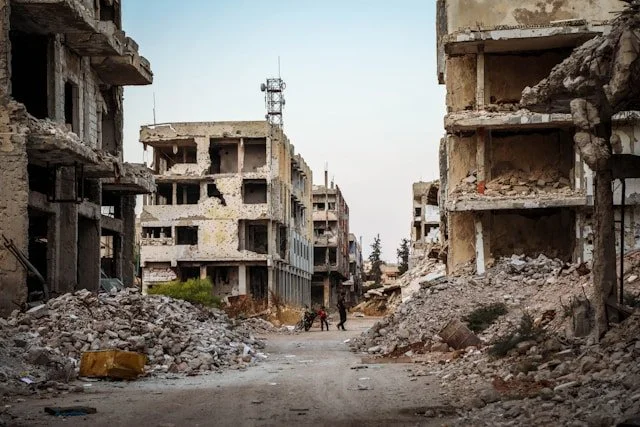
Credit: Mahmoud Sulaiman/Unsplash
Since the beginning of time, people have used violence to resolve disputes, disagreements, and conflicts. At any given time, war is happening all across the globe.
There are many violations of human rights during war–torture, devastation, destruction, death, and displacement, for example. However, there is a near-universal belief that there must be limits to protect innocent people (e.g., civilians, prisoners, the wounded, others) during wartime. This belief is the reason we have international humanitarian law.
What to Know
(Background information for educators that can be read aloud, shared, or summarized with learners)
What is war?
War is an armed conflict between nations, states, or organized groups. War involves violence, aggression, and military operations to achieve specific goals such as trying to secure resources or land, a clash of ideology or religion, security concerns like eliminating a perceived or real threat, status and power, and other reasons.
There are different kinds of wars:
International wars between countries (e.g., US-Israel and Iran, Russia and Ukraine).
Civil wars are armed and violent conflicts between organized groups within the same country (e.g., Myanmar, Sudan, Syria).
World wars (e.g., WWI, WWII) involve many of the world’s most powerful countries and take place across multiple continents and oceans.
Different countries have different constitutional, legal, and political procedures for formally declaring war. For example, in the US under the Constitution, only Congress has the authority to formally declare war, which is supposed to be voted on by a simple majority in the US House of Representatives and Senate. Since World War II, however, the US has engaged in extended military conflicts in various countries (i.e., Korea, Vietnam, Afghanistan, Iraq, and currently Iran) where declarations of war were never authorized by Congress. In most cases, Congress passed “authorizations for the use of military force” that allowed for the deployment of US troops without requiring a full declaration of war.
There are various wars taking place currently. To learn more, the Council on Foreign Relations has a Global Conflict Tracker, an interactive map covering nearly 30 conflicts of concern to the US, and which provide context, background, and visual impact. The International Crisis Group has a Crisis Watch, which tracks early warnings in over 70 countries, identifying escalation risks and opportunities for peace.
The rules of war and human rights
When wars take place, not only are the people directly engaged in the war impacted by being harmed, tortured, wounded, or killed, but others also suffer the consequences of war. Those people include civilians (people who are not members of the armed forces); detainees (people being held by the government, sometimes during military conflicts); journalists, medical and humanitarian aid workers; and those who can no longer fight (e.g., wounded soldiers). Important buildings such as educational institutions and hospitals are negatively impacted or destroyed during war, and innocent people are hurt.
International humanitarian law dictates what can and cannot be done during war to protect civilians and others. The Geneva Conventions and Additional Protocols are the most important laws and rules to prevent the brutality of war, violations of humanitarian rights law, human suffering, and war crimes. According to the International Committee of the Red Cross:
The 1949 Geneva Conventions and their Additional Protocols are international treaties that contain the most important rules limiting the barbarity of war. They protect people who do not take part in the fighting (civilians, medics, aid workers) and those who can no longer fight (wounded, sick and shipwrecked troops, prisoners of war).
The original Geneva Convention was adopted in 1864. Over several decades, many countries have steadily adopted them. In the 1950s, 74 states ratified the Conventions, and more have continued every decade since. Since 2000, the total number of countries to ratify the Geneva Conventions is 196, thereby making it one of the most widely accepted treaties in existence.
The Geneva Conventions and their Additional Protocols are a series of four international treaties established in 1949 and their three additional protocols, established after 1949, that form the core of international humanitarian law. The Conventions are very detailed, and each one contains numerous articles (some more than 100). They are summarized by Cornell Law School’s Legal Information Institute (LII) as follows:
Convention I (1949) protects wounded and sick soldiers and medical personnel who are not taking an active part in hostility against a party.
Convention II (1949) extends the protections outlined in the first Convention to shipwrecked soldiers and other naval forces, including protections for hospital ships.
Convention III (1949) mandates that Prisoners of War (POWs) receive proper and humane treatment, as specified by the First Convention.
Convention IV (1949) affords civilians (people who are not members of the armed forces) the same protections from inhumane treatment and attack that sick and wounded soldiers receive in the First Convention. There are additional regulations prohibiting attacks on civilian hospitals, medical transports, etc.
Protocol I (1977) implements additional restrictions on the treatment of “protected persons” and introduces new rules on the treatment of deceased persons, protection of cultural artifacts, and addresses dangerous targets (e.g., dams, nuclear installations).
Protocol II (1977) clarifies what “humane treatment” means and extends the essential rules of the law of armed conflicts to internal wars.
Protocol III (2005) adds the "red crystal” emblem to the list of symbols used to identify neutral humanitarian aid workers. It was adopted to address the need for a neutral symbol that does not carry the religious, cultural, or political connotations sometimes associated with the cross or crescent.
To learn more about humanitarian law during wartime, watch this helpful video from the International Committee of the Red Cross: What are the Rules of War?
Enforcement of the Geneva Conventions includes universal jurisdiction, which allows the national authorities of any country to investigate and prosecute people for serious international crimes even if they were committed in another country. According to Cornell Law School LII, “... universal jurisdiction is based on the notion that some crimes, such as genocide, crimes against humanity, torture, and war crimes, are so exceptionally grave that they affect the fundamental interests of the international community as a whole.”
What are examples of human rights violations during current wars?
International humanitarian law is being violated (broken, ignored, or disregarded) in wars currently taking place.
The Russian invasion of Ukraine (2022-present) has resulted in widespread violations of international humanitarian law. The UN Human Rights Monitoring Mission in Ukraine reports that conflict-related violence has killed more than 15,000 civilians and injured more than 41,000 others. Russia’s attack on Ukraine’s energy system has damaged and destroyed key parts of the electricity, heating, and water systems across the country. There has been widespread torture and ill-treatment of Ukrainian prisoners of war and civilian detainees.
The Civil War in Sudan (2023-present) has had a devastating impact on civilians in the country. More than 150,000 people have been killed and women and girls have faced gender-based and sexual violence. Since April 2023, approximately 14 million people have been displaced, including more than 4.5 million who have fled to neighboring countries. More than half of Sudan’s population faces acute food insecurity, including over 10 million facing severe or extreme levels of hunger. More than 70 percent of Sudan’s hospitals have been destroyed, leaving millions without access to essential medical care as disease outbreaks surge.
During the US-Israel War on Iran (February 2026-present), almost 2,000 civilians have been killed in Iran in airstrikes by Israel and the US. These airstrikes also hit schools, hospitals, cultural and religious buildings, and civilian housing. On February 28, 2026, the first day of the war on Iran, there was an unlawful US strike on a school in Iran that killed 156 people, including 120 schoolchildren. Human rights and international organizations have described the strike as a major violation of international humanitarian law.
Why It Matters
When war happens, many people who are not directly involved in that war get wounded, hurt, killed, or lose access to resources needed to survive. The Geneva Conventions and their Additional Protocols specify how these actions violate international humanitarian law. Many argue these actions are not only illegal but also immoral. Just because a country decides to provoke a war (and sometimes not even through the legal channels), innocent civilians and others should not be harmed or killed in the process. Some believe that war itself is inherently immoral because war is a “crime against humanity” that leads to widespread death and destruction. Even if you believe war is justified or justified in some circumstances, there is a universal belief that those not engaged in war should not suffer the effects of state violence. As historian Howard Zinn said, “There is no flag large enough to cover the shame of killing innocent people."
What You Can Do Right Now
(Ideas for learners to take action)
Help to organize a forum at school to discuss current or past wars and how they impact human rights. You can invite outside people who have expertise or experience with war to share their thoughts.
Learn about your elected officials’ positions on wars (or wars currently taking place) and what they are doing about it. If you are in the US, you can search by your address to find contact information for your members of Congress, who have a say about war. Share your thoughts about war in general, a specific war, or human rights violations during war.
Get involved in activism efforts about specific wars or war in general.
Learn about national and international organizations that advocate against war and for human rights such as Amnesty International, War Resisters League, Human Rights Watch, Nonviolent Peaceforce, and the International Rescue Committee. Get involved in their efforts or help to donate funds.
Conversation Starters and Sparkers
To engage learners in a discussion, use non-judgmental and open-ended questions. Non-judgmental questions are curious questions that seek to understand a person, perspective, or situation without making assumptions or judgments. Open-ended questions are broad questions that can’t be answered in one word or with a simple “yes” or no,” but instead are questions that lead to detailed responses that uncover a person’s opinions or feelings and keep the conversation flowing.
Ask any of the following questions or create your own questions:
What does war mean to you?
Do you or your family members have any personal connection to war–past or present? (For this question, do not have students share aloud; instead invite them to reflect to themselves silently.)
What did you learn about war and human rights that you didn’t know before?
Why do you think the Geneva Conventions were created?
What do you believe about war (e.g., that it is justified, sometimes justified, or inherently immoral?) Please explain your thoughts.
What do you think should be the rationale or reasons for going to war?
How would you explain the Geneva Conventions and their Additional Protocols in your words? How about international humanitarian law in general?
What do you think should be the consequences of violating international humanitarian law?
What’s your biggest takeaway from learning about war and human rights?
Resources for Further Learning
-
-
Armed Conflict (Amnesty International)
The Geneva Conventions and their Commentaries (International Committee of the Red Cross)
War and international humanitarian law (International Committee of the Red Cross)
Woven Teaching believes that human rights education is essential for students and adult learners to understand and assert their own rights and to protect the rights of others. As a result, the Universal Declaration of Human Rights (UDHR) lies at the core of Woven Teaching’s materials. The document’s 30 articles outline fundamental human rights: basic rights and freedoms which every human being is entitled to, regardless of race, religion, birthplace, gender, sexual orientation, or other characteristics. Although its articles are not legally binding, the UDHR serves as a moral compass for the international community. The concepts in this resource connect directly to several UDHR articles, including:
Article 3: Right to life, liberty and safety.
Article 5: Right to freedom from torture or cruel, degrading or inhuman treatment.
Article 9: Right to freedom from arbitrary arrest and imprisonment.
Article 13: Right to freedom of movement.